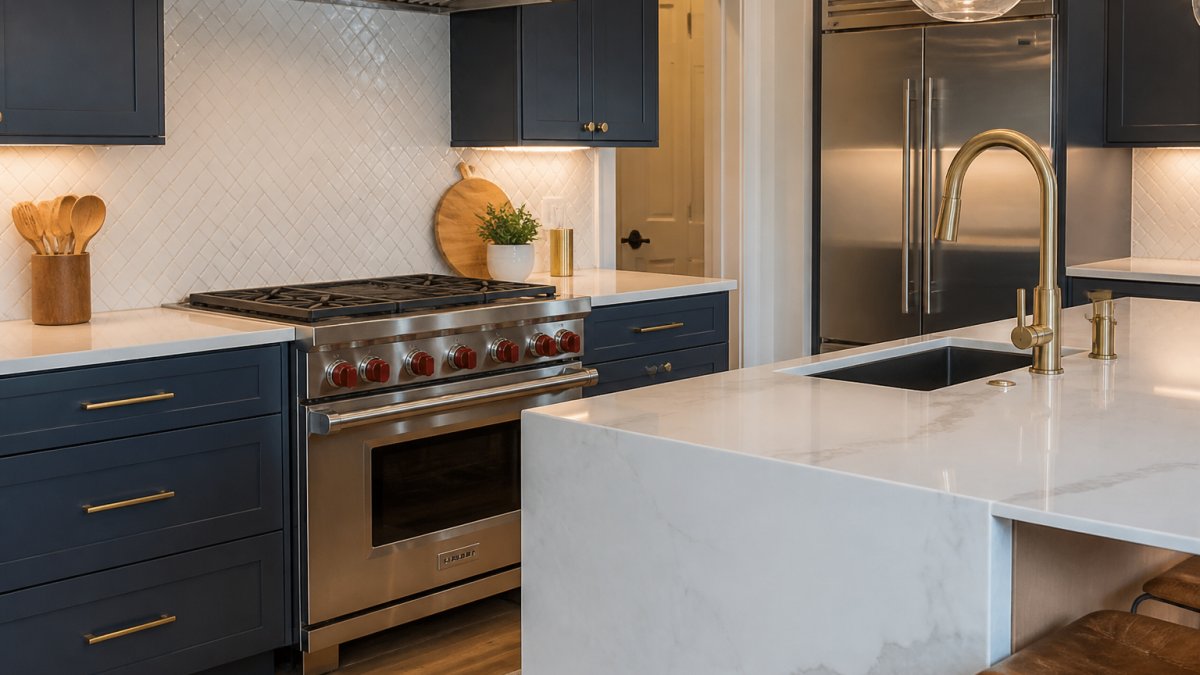
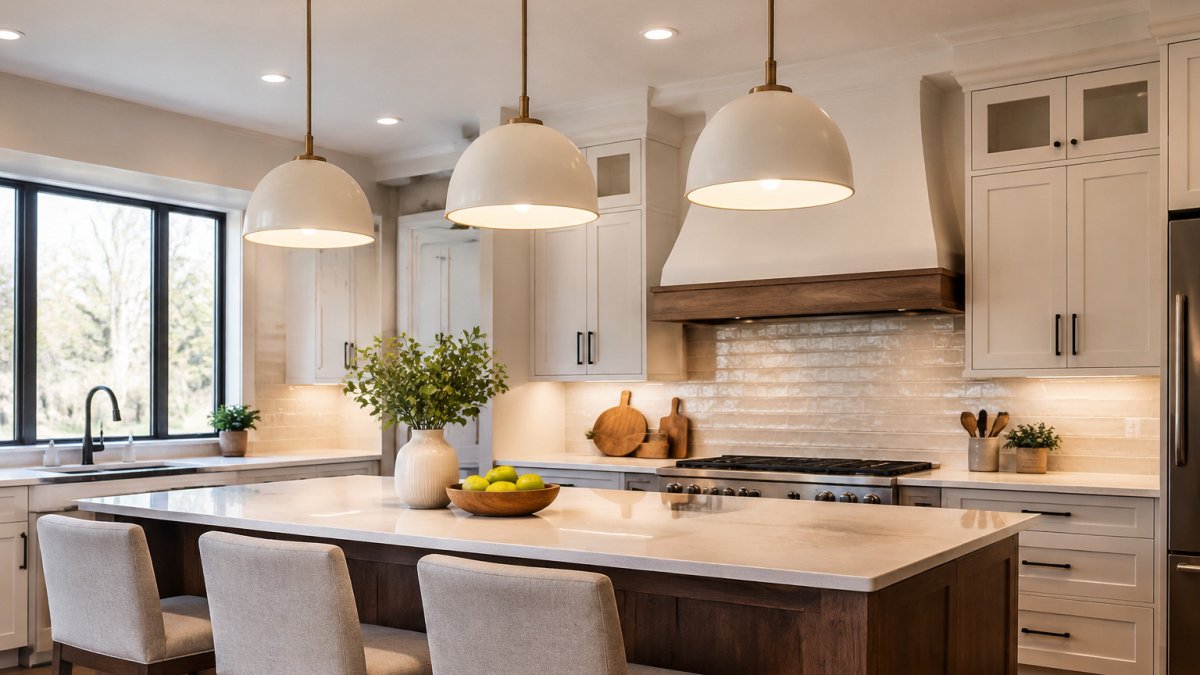
 listicle
Are Kitchen Lighting Trends Worth It in 2026?
Last Updated: November 5, 2026
Quick Summary
The kitchen lighting trends with lasting appeal in 2026 are warm color temperature, full-range dimming, and mixing metals with natural materials. None are dramatic, and all adapt as tastes shift, which is exactly why they last. Trends that solve a real task and use materials that age well keep working for twenty years.
- Warm light in the 2700K to 3000K range flatters wood, stone, and skin tones, while anything above 4000K reads clinical.
- The best ceiling lighting combines recessed lights for ambient coverage, task lighting over work zones, and one statement fixture.
- Hang the bottom of island pendants roughly 30 to 36 inches above the countertop and confirm the height with your installer.
- Layered lighting combines task, ambient, and accent light so each one does a different job and gives you control.
- On ceilings under about 8 feet, skip the heavy central pendant and use flush-mount or slim linear fixtures.
Table of Contents
- Why Some Kitchen Lighting Trends Last and Others Fade
- Kitchen Lighting Trends 2026: What's Actually Enduring
- The Best Lighting for Kitchen Ceiling: Recessed, Track, and Statement Fixtures
- Kitchen Island Lighting Trends 2026: Pendants That Will Still Work in 2036
- Layered Lighting: Task, Ambient, and Accent Working Together
- Small Kitchen Lighting Ideas That Don't Sacrifice Style
- Specs That Decide Whether a Fixture Lasts: Scale, Glare, and Lifecycle Cost
- Planning Your Kitchen Lighting Upgrade with Apex Building Group
- Frequently Asked Questions
Why Some Kitchen Lighting Trends Last and Others Fade
Walk into a kitchen remodeled in 2015 and the fixtures date it in seconds.
Trends with lasting appeal solve a real task, use materials that age well, and do not depend on a single dramatic silhouette.
Fads lean on one bold gimmick, a fixture shape, a metallic finish, a color temperature that photographs beautifully but feels cold at 7 a.m.
Kitchen Lighting Trends 2026: What's Actually Enduring
The most durable kitchen lighting trends in 2026 are warm color temperature, full-range dimming, and mixing metals with natural materials. None are dramatic, and all adapt as tastes shift, which is exactly why they last.
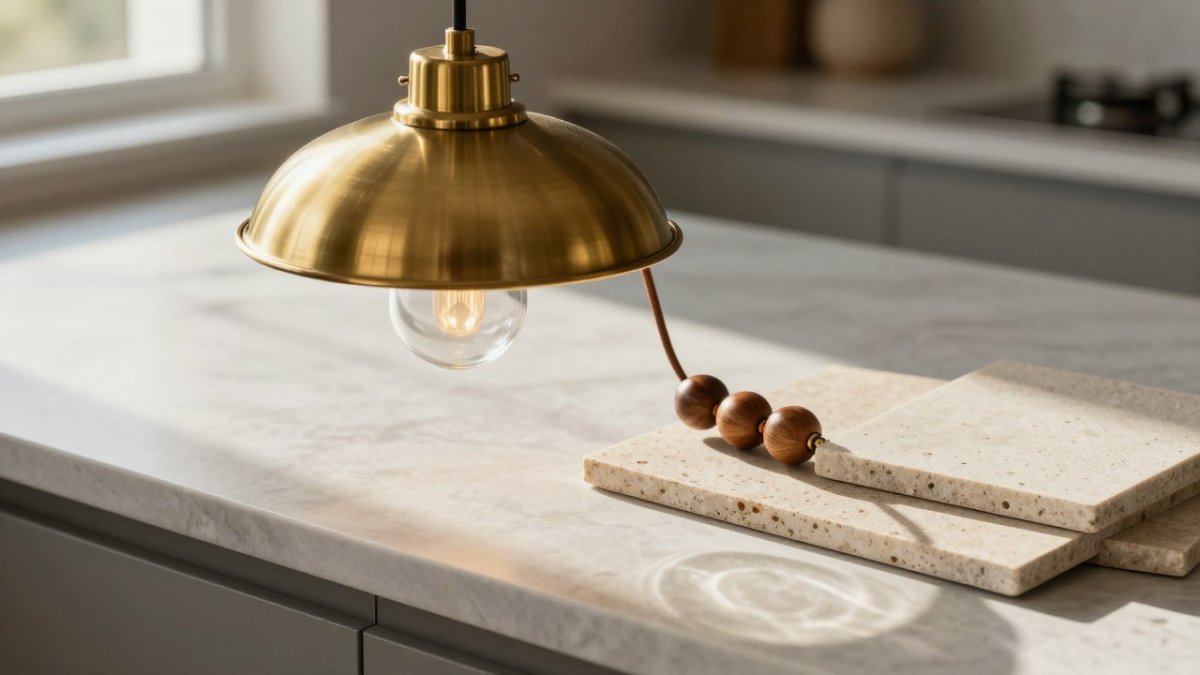
Warm Color Temperature and Full-Range Dimming
Color temperature measures how warm or cool a light looks, and it is the spec most homeowners never check.
Full-range dimming matters just as much. A kitchen needs bright, even light for prep and soft light for dinner, and fixtures that dim smoothly to a low glow without flicker give you both from one installation.
Mixed Metals and Natural Materials
Mixing metals stopped being a trend years ago and became standard practice. Brushed finishes, glass shades, wood, and bamboo sit comfortably together, and a mixed palette lets you change one element later without replacing everything.
Natural materials also age honestly. Wood shades and bamboo develop a patina instead of chipping. Glass stays neutral. High-gloss colored finishes are the ones that look dated first.
The Best Lighting for Kitchen Ceiling: Recessed, Track, and Statement Fixtures
The best lighting for a kitchen ceiling combines three layers: recessed lights for even ambient coverage, task lighting over work zones, and one statement fixture for character. What separates a scheme that lasts is the layout math and the specifications behind it.
Recessed Lighting: Placement and Spacing
Recessed lighting does the quiet work. Placed on a grid that follows your counters, it washes the room evenly and disappears into the ceiling. It is the least trendy choice on this list, and that is its strength.
The goal is even coverage without hot spots or shadows where you chop.
Ceiling height changes the plan, so fixture choice and placement should be matched to the room.
Track Lighting: When It Earns Its Place
Track lighting lets you aim each head where you need it, which can suit kitchens with awkward ceilings.
Statement Fixtures: One Bold Element, Classic Form
Statement fixtures carry the personality. A sculptural pendant or linear chandelier over an island gives the room a focal point, so keep the piece classic in form and let it be the one bold element. Proportion matters more than style: too small and it disappears, too large and it dominates the sightline from the next room.
Glare and Comfort on the Ceiling Plane
Glare is the most common comfort complaint in kitchens, and the ceiling is where it starts. Bare bulbs and unshielded downlights bounce light off polished counters into your eyes while you cook; deep-set recessed trims, diffusers, and shielded pendants solve most of it. If anyone in the household is light-sensitive, favor fixtures with a recessed bulb or diffuser over open-bulb designs.
Dimming and Controls
Layering light on separate controls lets you run bright, even light for prep and soft light for dinner.
If you want to see how these three approaches look installed in finished rooms, browse the kitchen remodeling projects we have completed.
Kitchen Island Lighting Trends 2026: Pendants That Will Still Work in 2036
The pendants that will still look right later are generally the ones that do not depend on a novelty shape.
Scale is where most island lighting goes wrong.
A practical rule: hang the bottom of the pendant roughly 30 to 36 inches above the countertop, high enough to see across the island and low enough to feel deliberate.
Layered Lighting: Task, Ambient, and Accent Working Together
Layered lighting is the practice of combining task, ambient, and accent light so each one does a different job. A kitchen with only one layer feels either dim or harsh. Three layers give you control.
- Ambient lighting fills the room with general illumination, usually from recessed ceiling lights or a central fixture.
- Task lighting focuses on work surfaces: under-cabinet strips, pendants over the island, and lights over the sink and range.
- Accent lighting adds depth, highlighting a backsplash, open shelving, or a piece of stone.
Sconces and small secondary sources belong here too. A wall sconce beside a window or a slim light over open shelves softens the room and gives you a low-light option for evenings.
Under-cabinet lighting lights the counter where you actually chop.
Small Kitchen Lighting Ideas That Don't Sacrifice Style
Several smaller, well-placed light sources can make a compact kitchen feel larger and brighter. The practical question is how to place them when the ceiling is low, the room is narrow, or the kitchen opens onto another space.
Low Ceilings
On a ceiling under about 8 feet, headroom is the constraint. Skip the heavy central pendant and use flush-mount or slim linear fixtures that sit close to the ceiling. Recessed cans with shallow housings or surface-mounted LED panels keep the plane clear. If you want a pendant over a small island, keep the drop short and the shade compact so it does not block the sightline across the room.
Narrow Galley Kitchens
In a galley, the work happens along two parallel runs, and the light should follow them. Run under-cabinet strips along both counters and place recessed cans in a line over each run rather than down the center of the aisle, center-line cans light the floor, not the work. A single slim fixture down the middle adds ambient fill without crowding the aisle.
Large Islands in Small Rooms
A large island in a small kitchen is common in open-plan homes and changes the math. Two or three pendants scaled to the island read as intentional; one undersized pendant reads as an afterthought. Keep the bottoms roughly 30 to 36 inches above the countertop and confirm the height with your installer.
Open-Plan Sightlines
When the kitchen opens onto a living or dining area, the lighting has to work from both sides. Choose fixtures that look finished from the living room, not just from the cook's side, and keep the color temperature consistent across the connected spaces so the kitchen does not read as a separate, cooler room. A warm 2700K to 3000K across the whole open plan is the usual choice.
Materials and Surfaces That Help
Glass shades help in small spaces because they let light pass through instead of blocking it. Light-colored ceilings and a warm color temperature make the room feel open, and mirrors and glossy backsplashes bounce light around a tight kitchen.
Glossy surfaces can also amplify glare, so diffused or shielded fixtures are often a better choice than bare bulbs.
Comfort and Accessibility
Small kitchens often serve households with mixed lighting needs. Older eyes need more light on the work surface, while glare becomes more bothersome with age. Under-cabinet task lighting with a diffuser gives you brightness where you need it without shining into your eyes. Put the most-used switches where you enter the room, and consider a dimmer so the same fixtures can go from prep-bright to dinner-soft without adding fixtures.
Specs That Decide Whether a Fixture Lasts: Scale, Glare, and Lifecycle Cost
Durability in kitchen lighting depends on several factors, including fixture scale, glare control, energy use, and maintenance access.
Scale is about proportion. A fixture should relate to the island, the ceiling height, and the room.
Glare control protects comfort.
Energy and lifecycle cost matter more than sticker price.
Maintenance access is the spec nobody mentions. Fixtures over a tall island or a stairwell are hard to reach.
| Spec | What to Check | Why It Matters |
|---|---|---|
| Scale | Fixture size vs. island and ceiling height | Prevents a crowded or empty look |
| Glare | Deep trims, diffusers, shielded bulbs | Keeps cooking comfortable |
| Energy | Dimmable LED, quality driver | Lower running and replacement cost |
| Access | Replaceable bulbs and drivers | Easier long-term maintenance |
For a broader look at which finishes and layouts are already dated, our companion piece on kitchen trends outdated in 2026 pairs well with this guide.
Planning Your Kitchen Lighting Upgrade with Apex Building Group
A lighting upgrade is often easiest to plan alongside a larger remodel, when walls and ceilings are open and wiring can be run cleanly.
If you are still deciding how to bring in design help, our guide on how to pay someone to design your kitchen explains the options. For a sense of what a full renovation involves locally, see what to expect from a kitchen remodeling project in the Greater Boston area.
Apex Building Group handles permits, design consultation, construction, and inspections under one roof. Our team manages the project from start to finish.
When you are ready to move from ideas to a plan, book a free estimate and we will walk your kitchen with you.
The difference between lighting you love for a decade and lighting you regret in three years comes down to a few quiet decisions: warm color temperature, layered light, honest materials, and specs that hold up. If you are planning a kitchen upgrade in Greater Boston, Apex Building Group can help with expert project management, customized solutions for your home, and licensed, insured general contracting from start to finish. Get started with Apex Building Group and build a kitchen that still looks right in 2036.
Frequently Asked Questions
What is the latest trend in kitchen lighting?
The most durable trend is layered lighting: recessed or track ceiling lights for ambient coverage, pendants or a chandelier over the island, under-cabinet task lighting at the counters, and sconces or accent lighting for depth. Warm color temperature around 2700K to 3000K with full-range dimming is now standard in quality schemes. These choices work across styles, which is why they hold up better than any single fixture shape or finish that dominates one season.
What kitchen lighting trends will feel dated in 2026?
Trends that tend to age quickly are the ones tied to a single look: oversized bare-bulb clusters, uniform cool-white LED strips with no dimming, and matching every metal in the room to one finish. Anything installed without dimming or layered control also feels dated fast, because the room can only be one brightness. If a fixture only works with one cabinet style or color palette, it is a short-term choice, not a lasting one.
What is the best lighting for a kitchen ceiling?
Recessed LED downlights remain the workhorse for general illumination, spaced so countertops and walkways are evenly lit without shadows. Track lighting suits kitchens where you want to aim light at specific zones or avoid cutting many holes in the ceiling. A statement fixture, such as a linear pendant or chandelier, adds character over an island. Most well-lit kitchens combine two of these rather than relying on one type alone.
How do you choose pendant lights for a kitchen island?
Start with island size and ceiling height. Consider the island size, ceiling height, and sightlines when choosing how many pendants to hang and how high to hang them. Choose a shade style that reads neutral, like glass, metal, or wood, so it still fits if you repaint cabinets later.